
Planning for a Quinceañera
Planning for a Quinceañera
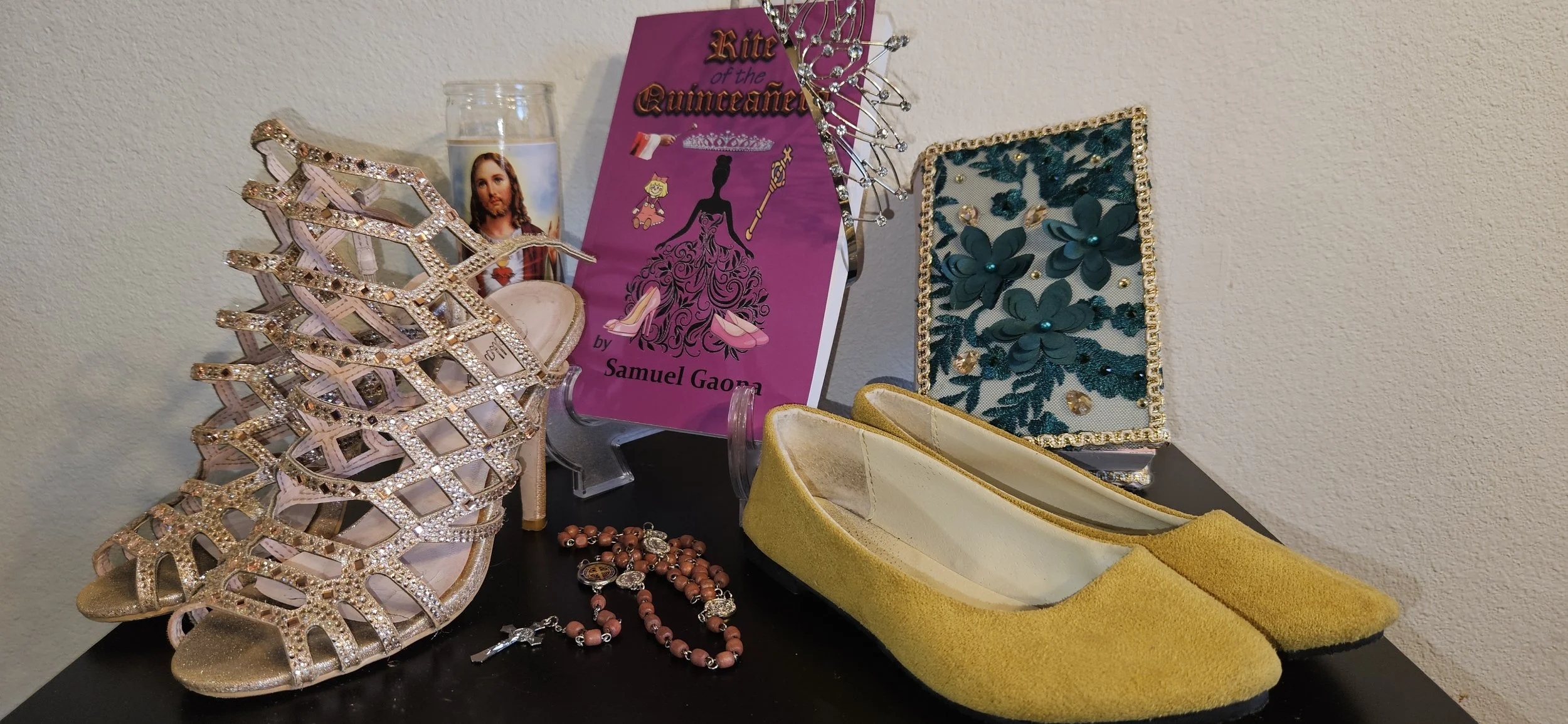
Quinceañera Mass Planning for parents and Godparents
-
Your daughter's Quinceañera experience is not just the day. The planning, the preparation, the practices, are all part of the Quinceañera experience.
When planning a Quinceañera, what and when are usually the easiest to check.
What: Quinceañera, 15th birthday
When: a date on or near her 15th birthday
Why can get a little complicated. Some families see the Quinceañera as a Rite of Passage and expect their daughter to participate. Other families see the Quinceañera as a Coming of Age celebration and so conditions may be set if the young woman wants to have a Quinceañera.
Why: old customs celebrated a females transition from little girl to woman. Modern times has inserted young adulthood, and so the Quinceañera today celebrates a little girl who is now a young woman, on her path toward being an adult in womanhood.
How, where and who can be the most complicated.
Where: Church for the Blessing? Venue for the reception?
Usually, parents want "where" to be established by her 14th birthday, so that they have a year to fill those locations with everybody; and everything.
Who: the Quinceañera (of course), the parents (of course), priest or deacon for the Blessing(?), Godparents and sponsors (Padrinos), Court, guests.
If her Court or guests include friends of hers, be sure to consider if that friend has siblings and include parent(s) toward your headcount.
How: Financing a Quinceañera may require a budget and budget planning. Early planning can help the success of the event. Not only will the family want to determine what they want and like, they will have to balance those desires within the budget.
While mapping out "who" will be involved, before expanding the guest list, start with who is necessary and expand your guest list from this base.
Part of your venue selection will be cost (budget) and capacity (guests). Venues may offer amenities for additional cost, but if they can't fit everybody, you may find another venue or trim your guest list accordingly; before invitations go out.
Quinceañera's are well known for their formal attire, banquet like feast, and dance. If you're having food and need a dance floor, don't forget to consider the room space available as well as the impact the dance floor and dinner will have on seating for guests; the dance floor and tables for food may reduce seating in some venues.
Once you have your budget and number of people, you want to get with your Church. Not all Catholic parishes celebrate the Quinceañera.
Some parishes have a single day to celebrate all the Quinceañera blessings for the single month. You may have to look further if you want your daughter to have her own Quinceañera Mass.
Also, Catholic parishes may have requirements to be eligible to celebrate a Quinceañera Mass; which might include reception of the Sacraments of initiation, regular Mass attendance, youth group participation, etc. Although the Quinceañera is not a sacrament, she may also be offered the Sacrament of Reconciliation before celebrating the Quinceañera Mass.
Knowing the date of the Quinceañera Mass will help line up the venue scheduling.
**if you've hired an event coordinator, the 3 things they'll need to know is 1) when, 2) how many people and 3) how much is in the budget
Everything else will stem from these three, things like the venue with that date and enough seats, followed by food and entertainment.
-
The time of the Quinceañera is pivotal in a female's life. In times past, the Quinceañera was a Rite of Passage from a girl into womanhood. In modern times, often emphasized as a Coming of Age celebration, the Quinceañera marks the time when she is progressing from the stage of a little girl to a young woman, on her path to being an adult in womanhood.
There are several common items involved in the Quinceañera. Some are so common that sometimes it's just given that they will be part of the Quinceañera without considering their meaning or significance.
We will explain here about those items to explain why these items are there. Some have purely religious significance. Some have purely social significance. Many, however, have both social and religious significance. We will present these common traditions and gifts thoroughly, addressing social significance, religious significance, and both where appropriate.
This isn't going to be a completely exhaustive list, and this is not a to do list either. Some traditions will have greater emphasis due to cultural and familial influence. Other traditions may be opted out. There may also be other exclusive traditions unique to your family that may not be covered here.
Items she might wear
Tiara
Starting from the top, the tiara will clearly set apart the Quinceañera girl from everyone else. This is her special day and she will be treated like a princess. It's pretty simple socially. Religiously, the tiara should also be a reminder of Baptism.
Human dignity is inherited by physical birth and 15 years of physical life is evident with a Quinceañera. Human dignity should be respected from conception to natural death, because we were all created in the image and likeness of God.
A princess is a daughter of a king. By the Grace of her Baptism, she is the daughter of the king of kings. For God gave us a new birth… ‘to an inheritance that is imperishable, undefiled, and unfading, kept in heaven for you” (1 Peter 1:4).
Another little bit about the tiara, it is not required, but more often than not, the Baptismal Godparents provide the tiara. In other cultures and non-Catholic faiths, faiths that do not participate in infant Baptism, you might find this honor reserved for her mother, as her mother protected her human dignity in the womb and brought her into the world.
Earrings
Earrings given at the Quinceañera are typically more elegant than any other earrings previously given to her as a child. It doesn't have to be expensive, these earrings could also be fragile heirlooms being passed down, but it's usually a step up as far as the metal and/or jewels.
These upgraded earrings come as a token of maturity, as she is progressing from girl to young woman. There is hope and prayer attached, as the family certainly desires that she will hear and heed the voice of God. There is hope and prayer that when God calls her to serve God and his people, that she may hear that call, that heavenly invitation. For “blessed are those who hear the word of God and observe it.” (Luke 11:28)
It is not required, but since earrings religiously involve a potential call to mission or service, her Confirmation sponsor could be involved in putting them in her ears.
Parents and sponsors will usually provide the earrings, which can vary and depend on whether the earrings are being passed down (earrings from parents or grandparents might be passed down) or bought brand new; selected by the sponsor(s)/padrino(s).
Necklace
Necklaces are likewise of a higher elegance than any previous necklace given. The earrings and necklace usually come in a set if bought for the occasion.
Socially, it is another sign of maturity, to be responsible to care for it. In non-religious observation, you might hear it having to do with maintaining a cheerful heart in good times and bad.
Religiously, as the Proverbs 3 advises her to “not let love or fidelity forsake you, rather bind them around your neck, write them on your heart.” This is to encourage her to pursue her call in good faith. (Proverbs 3:3)
So, the earrings might be to encourage what the young lady wants to do with her life, and the necklace says to live out her life choices well.
Purity Ring
Purity rings are pretty simple, as this is a ring to remind young ladies to guard their chastity and virginity. It is also a sign of abstinence for anyone to see publicly, so socially, a Purity ring communicates that she is saving herself for marriage.
The Quinceañera is not a wedding, although there are many parallels. In a wedding she binds herself and pledges herself to her husband. In the religious, Catholic, Quinceañera she renews her Baptismal promises. Whether Catholic or not, the young lady says a prayer of consecration to God. With Jesus as the bridegroom, the purity ring can be a sign of that binding to God.
Whether worn on the left or the right, the purity ring does not come off until a wedding ring goes on. Not the promise, not the engagement ring, the wedding ring.
As Song of Songs 2:7 goes
“I adjure you, Daughters of Jerusalem, by the gazelles and the does of the field, do not awaken, or stir up love until it is ready.”
Shoes/High Heels and Exchange
Shoes are exchanged. More often than not, flat shoes are exchanged for high heels. The shoes and the action of the exchange both have significance. The flats represent the stage of a little girl, with the heels representing the maturity of a young woman on her way to womanhood.
A good amount of cultures reserve this shoe exchange for dad, or the parents. She does not change her own shoes. The action of changing the shoes, with dad for example, is for himself, and on behalf of his family, public acknowledgement that his daughter is not a little girl anymore.
Religiously, there is hope and prayer that they have given her a firm foundation to stand tall in the faith. There is hope and prayer that she will rise up to her calling. There is also hope and prayer that she will continue to walk with God, walk in the righteous, upright ways of the Lord.
Items she might hold
Scepter
A scepter is a sign of power and authority. The Scepter doesn't show up as much in the U.S. since America is a democracy, that the people have the power to vote and government branches have checks and balances.
The Scepter shouldn't represent one to be served, although she'll be getting and getting for her Quinceañera. The reality is that as she gets older, she will be given more freedom to make choices.
In a kingdom, the king and queen have the power and authority to make decisions. However, the weight of the Scepter is to acknowledge that your decisions will impact more than just yourself. And so taking responsibility when making decisions, when exercising her authority, the hope is that she will consider not just what her decisions will affect, but also who those decisions will impact.
Jesus told his disciples that they are not to lord their authority over others like the Gentiles do. Jesus also said that he came to serve, not be served, Matthew 20:25-28. There is hope and prayer in this Scepter, that as she gains decision making authority, that she will use that authority well.
Bible
For some young ladies, the Bible presented at their Quinceañera will be their first Bible. Here in America, young ladies could have 2 or more already.
1 Bible is provided for study during Sacramental Preparation. After receiving the Sacraments, a Bible is a pretty common gift too. The Bible commemorates new, important stages in your life.
Study and formation, there's a Bible. Living in the Grace of the Sacraments, there's a Bible.
There's a bit more ceremony in the presentation of the Bible in the Quinceañera, but once again a new stage in her life journey, being a young woman, there's a Bible.
The social aspect in presenting the Bible involves the expectation that as her maturity grows, whether she is reading the Bible or hearing it read in Mass, her understanding of the sacred text should grow as well.
Rosary
Most young ladies will own a Rosary by the time they celebrate their Quinceañera. Like the Bible, the Rosary marks important times or stages, and the Rosary has this public presentation to remind you to pray always.
As Mary kept many things in her heart, the Rosary presented at the Quinceañera is usually a nicer Rosary, to visually, physically signify that she is entrusted to keep the mysteries of our faith with a sense of responsibility. By meditating on the mysteries “we may imitate what they contain, and obtain what they promise.” (Final Rosary Prayer)
Doll(s)
2 dolls that are most common in the Quinceañera are the “Last Doll” that the Quinceañera girl will receive and the doll the Quinceañera girl gives away.
The last doll is usually given by the parents, it's the last toy they will buy her, since she is not a little girl anymore. Sometimes this last doll is given before the celebration and displayed among the decorations. It could also be given ceremoniously during the celebration.
It's not a doll type that would get played with, as this doll is typically glass or porcelain, not plastic. Although her adolescence is coming to a close, she is encouraged to keep and preserve that which is good from her childhood. She should honor her adolescence, as it has brought her this far.
Things like her innocence, her purity, should be sought to stay intact; don't be a child but keep a childlike faith in your heavenly Father. Young women should know that no matter how mature you feel, or how grown you think you are in the years to come, you'll always be a daughter.
A second doll is given away by the Quinceañera girl to a younger girl. In some traditions, the little girl receiving the doll could be a younger sister or younger cousin, typically the next girl in line for a Quinceañera of her own.
It's not hard set that it is the immediate next in line, as a 13 or 14 year old might be already feeling the pressure of putting away childish things.
And so the age may be more of a factor in deciding who the doll will go to, selecting a different younger girl, age range 5 to 10 years old. So she can participate in the giving of the doll, but also have some time to play with the doll while in her adolescence.
The significance in giving the doll could be 3 reasons.
First, the Quinceañera girl is giving away the doll, so as to put away childish things as a young woman.
Second, the Quinceañera girl is telling the younger girl to enjoy her childhood.
Third, a little less common, is the pledge to this younger girl that as a young woman, she will take a certain sense to protect and provide the innocence of the younger generation. She is gaining the little girls trust with a toy. So there's an expectation that as a young woman, she will set a good example for the younger generation looking up to her.
Traditions involving others
Limo
In times past, towns and villages were much smaller than the cities lived in today. Back then, the Quinceañera leaving the Church, as the reception didn't take place in the Church, would be processed around town, like a celebration parade. Her court, friends and family would scream and shout with joy announcing her name through the streets. The court, parents and Godparents would lead, sometimes even carrying her to parade her around.
In modern times, with financing, a limo or a Padrino with a long bed truck, like for parade floats, would cruise the Quinceañera girl with her court through the city.
Court
A royal court for the Quinceañera is mostly made up of family and friends whose age is in close proximity with 15, the age of the Quinceañera girl.
Court numbers can vary, but the majority of cultures consider a full court to include 7 boys, 6 girls and 1 flower girl. The court adds up to 14, with the Quinceañera girl being the 15th person at her 15th birthday.
The girls are referred to as “damas” and “chambelanes” refers to the boys. 6 pairs of boys and girls, chambelanes y damas, the 7th boy, as the main chambelan, is the counterpart to the Quinceañera girl, or her escort. Not a chaperon, not a date, but there to accompany the young lady during this special occasion.
It is not required so much these days, but most commonly in history, the main chambelan was an older brother or older cousin, who was not quite the age of an adult yet. The modern norm is a boy between 16 and 18 years old, relative or son of a close friend to the parents; not a boyfriend. The main chambelan can be younger, but most families will agree that the main chambelan cannot be over 18, still in school, nor younger than 12, at least in middle school.
The flower girl and the girl that receives the doll from the Quinceañera girl are usually the same girl these days. Typical age range is elementary school. This could be a younger sister, a younger cousin, or daughter of a close friend to the parents. The flower girl represents the innocence and purity that Quinceañera girl is bringing to the altar in Mass, as well as to the community. The flower girl goes before the Quinceañera girl because innocence and purity are not a thing of the past that she is putting behind herself.
Dance
The Quinceañera reception will usually involve a meal, a banquet or a dinner of sorts, and having a dance in the Quinceañera girls honor is pretty common.
David danced when the Ark of the Covenant was brought into the Holy city, 2 Samuel 6:14. So dancing and celebration go pretty far back. As Ecclesiastes 3:4 states that all is in due time, in due season, there is a time to mourn and then a time to dance. So dancing associated with happiness goes pretty far back.
Having a dance can be a form of entertainment for your guests, but should also be a sign of joy and celebration.
Waltz
If you do host a dance, her court may participate in a formal Waltz. The Vals includes the 6 pairs of boys and girls, chambelanes y damas, along with the Quinceañera girl and her counterpart would be her main chambelan. The traditional Waltz gives cultural and familial honor, pays tribute to the past generations.
The Waltz has stood the test of time as the dance of the Quinceañera for a couple of reasons.
When compared to other popular European dances, the Waltz begins to make a little more sense. Take for example the Polka, which is perceived as more fun than serious. As young adults, she wants to be taken seriously by the older generations.
Therefore, a mature dance makes that statement of maturity. On the other hand, another popular European dance is the Tango, which is serious, but it's also a dramatic dance, and the Quinceañera doesn't want a drama scene that is too serious.
The style of the Waltz displays lady like and gentleman like conduct, expressed in her participation. The Waltz also has a certain elegance which communicates dignity and grace. And so it remains a beautiful dance for such a beautiful occasion.
Father/Daughter Dance
If there is a dance held, there's a good chance that the Father and Daughter will share a dance.
If the Quinceañera girl dances with only her father, then this dance can be viewed as a “to be continued” dance that will finish with another Father and Daughter Dance at her wedding.
Another style of Father/Daughter Dance involves the eldest patriarch, grandpa for example, starting the dance, representing God who gives dad his daughter. She is passed onto dad, who then passes her onto her main chambelan, with her main chambelan representing a future husband, if she pursues Matrimony. If she pursues the consecrated life, the main chambelan would represent Jesus, the bridegroom.
Not knowing the future, dad willingly passing her onto the main chambelan, is dad expressing that he will not hold her back from whichever vocation she is drawn toward.
Surprise Dance
It can happen after the Waltz, it can happen after the Father/ Daughter Dance, it can happen at any time. It's not surprising that a non-traditional dance takes place. In fact, the people that know the Quinceañera girl well enough know whether or not it's coming.
This dance is to be choreographed and practiced by just the court in secret. No one else should know the song or the steps.
People don't know if this dance will be to a 1920's jazzy big band, 1950's rock n roll, 1970's funk, 2000 reggaeton, maybe a number 1 hit from the year she was born… and that is where we find the surprise. This is her opportunity to show her creativity and/or her uniqueness. The surprise dance can be a personal expression of the Quinceañera girl.
Some young ladies will take this opportunity to pick a song that represents her, or says this my style, this is me. In some cases, if there's distant family coming, family not seen in a long time or family never met, the choreography might tell a story to show how she became the young woman she is today.
Young ladies, if you decide to have a surprise dance, the song and dance will be chosen with your authority. There is much room to present your individuality. However, the challenge with the surprise dance sometimes is keeping it modest and tasteful.
So keep in mind as you're the center of attention, your family will be watching and there might be some little girls looking up to you. It would be wise to consider what kind of example you intend to set, as well as how you want to be received as an individual among your family and your community.
-
The Order for the Blessing of the Fifteenth Birthday can be as simple as approaching a priest or deacon for the Blessing in the Church, outside of Mass.
However, there may also be a more elaborate celebration allowed, according to the United States Conference of Catholic Bishops, usccb.
When making preparations to celebrate a Catholic Quinceañera Mass, a few things to note immediately is that not all Catholic Parishes participate or schedule Quinceañera Masses. Parishes that do participate in Quinceañera's can fall into two categories:
They allow a Quinceañera Mass to be scheduled for the individual young lady
There is a day each month dedicated to collectively celebrate all the Quinceañera's for that month
If your home parish does not celebrate Quinceañera's, you may contact other Catholic parishes. If your home parish celebrates Quinceañera's collectively, but you desire she has her own individual Quinceañera, then you can reach out to other Catholic parishes.
Parishes that allow for individual Quinceañera's don't usually schedule more than 13 months in advance, but can definitely vary from parish to parish. Scheduling an individual Quinceañera Mass may also be up against other Quinceañera’s scheduled or Weddings scheduled on or near her Fifteenth Birthday.
If your daughter has not turned thirteen yet, it would be good to find out early on and give yourself time to check other parishes, if needed.
Prerequisites
Requirements to participate in a Quinceañera Mass can also vary parish to parish.
Most will have requirements involving Sacraments, regular Mass attendance, potentially formation, as well as some sort of ministry.
Sacraments of Initiation are Baptism, Confirmation, and First Communion.
If your Archdiocese has adopted Restored Order, most young women will need to have fulfilled all 3 Sacraments of Initiation before the Quinceañera. If not, the young woman will need to have Baptism and First Communion already, while being enrolled in Confirmation classes; or receiving Confirmation before the Quinceañera.
Unless your priest is familiar with your family, there may be a Mass attendance tracker to be signed weekly for a determined amount of time.
Youth Group is the most common ministry requirement. But if your daughter is in youth choir, for example, or other youth ministry, involvement may be considered.
Formation for a Catholic Quinceañera typically revolves around taking Chastity classes. Duration and curriculum can vary. Some Parishes may also include recommended literature. Books like Rite of the Quinceañera can complement existing curriculum while raising important social and religious dialogue among the family. For some Parishes, they request an essay about why the Quinceañera Mass is important to her. This book can help a young woman not only have a greater understanding of the importance but help her articulate that importance as well.
The preference is to have most, if not all, of these completed by her fourteenth birthday, so that she can be registered for her Quinceañera and the date scheduled.
In relation to booking a venue for a reception, the Mass and venue are normally sought to be secured by her fourteenth birthday; before invitations are sent.
If your daughter is already fourteen and you're just getting started with the Quinceañera Mass planning, take a breath and remember that the Catholic requirements are not entirely a conflict.
Sunday Mass can be fulfilled with a Saturday anticipatory Mass. Most youth groups and Sacrament Preparation occur during the week. These, most of the time, will not interrupt dress fitting, choreography practice and cake tasting Saturdays.
The Quinceañera formation or chastity class may have limited availability, but will only be a small portion of the overall planning and preparation.
Order of the Mass and where Rites of the Quinceañera are inserted
You've found a parish, you have the date for the Quinceañera, you're working on completing the prerequisites with the Church… now to prepare for the Quinceañera Mass itself.
The Order of the Quince Mass is as follows:
Introductory Rites
Entrance with opening Hymn, celebrant (priest or deacon) procession. The procession may include a Court, Padrinos, parents and the Quinceañera herself. This can be modified for individual or group XV Mass.
Penitential Act seeking God's mercy as a group, which usually involves “Lord have mercy, Christ have mercy, Lord have mercy”
Gloria? Not all Quinceañera’s will include the Gloria* but it is sung or said if it is included
Opening Prayer in which thanks is given to God for his divine mercy and love
Liturgy of the Word
First Reading is usually from the Old Testament
Psalm which is in response to the First Reading, can be said or sung, but response should be as a group
Second Reading is usually from the New Testament
Gospel is proclaimed by the celebrant (priest or deacon)
Homily is a preaching or teaching by celebrant, *some celebrants will ask for reasons why certain Readings were chosen and reasons can help for a more personal and unique homily
Quinceañera Rite:
Renewal of Baptismal Promises
Prayer of Consecration
Liturgy of the Eucharist
Profession of Faith in a Sunday Mass or Holy Day of Obligation is usually the Nicene Creed. The Creed is typically omitted for a Quinceañera Mass, as a Quinceañera Mass does not fulfill Keeping Holy the Sabbath unless it is included in a Sunday Mass or an Anticipatory Saturday evening Mass
Intercessions are the prayers of the faithful, usually tailored to the Church leading the world, leading the youth and for the Quinceañera’s journey in young womanhood
Offertory/Collection which the family usually pays for the Church and is why there isn't typically a Collection during a Quinceañera Mass. Offertory, however, can be in prayer and can include people bringing up the bread and wine to the priest; typically Padrinos, sponsors or Godparents, will be elected to this role
Eucharistic Prayer is the time when the bread and wine are being offered, when those in attendance are invited by the priest that “may my sacrifice and yours be acceptable to God the almighty Father”
Consecration is when the bread and wine become the Body and Blood of Jesus Christ
Our Father/Lord's Prayer is prayed as a community
Sign of Peace is a time to offer peace with one another, *you may want to coordinate some to offer peace to the Quinceañera if she is having her own Quince Mass and is seated alone in the front of the altar
Communion is the time for those who have been prepared to receive the Eucharist, *the Quinceañera is usually offered Communion first and then the rest of the guests may line up, **those who are not able to receive the Eucharist can receive a blessing in line with a predetermined signal, such as crossing their arms across their chest and heart
–during the administering of Communion, the Church does not force anyone to participate in the Holy Communion procession, but parents may invite or set as a condition for the Non-Catholic Court members to receive a blessing.
*This will be logistic, so Catholic Court members won’t have to step over somebody to receive.
**This is also invitational, since the Court are guests of honor, they can participate and get a blessing, NO Eucharist–
Quinceañera Rite:
Flowers for Our Lady (optional) but a prayer typically accompanies the flowers that Mary will intercede on her behalf and be a model of purity as she goes forth into maturity and responsibility
Presentation of gifts* with blessing of gifts* which may require a rehearsal to identify which Padrinos and which gifts will be involved. The Bible and Rosary are commonly blessed, the dolls or scepter are not typically blessed. Earrings, necklace, purity ring, etc, you'll want to coordinate with the celebrant as to 1) what can be blessed and 2) how they prefer logistically to bless and present; things like where to stand and order of presentation for example might be covered in a rehearsal
After her gifts have been blessed and presented, then her Blessing of the Fifteenth Birthday follows
Final Blessing is for everyone, including the Quinceañera girl
Dismissal is a sending forth to “proclaim the gospel with your life”
Quinceañera Mass roles and roster
There is usually a final meeting ahead of the Quinceañera Mass. From the original scheduling to that final meeting, here is a breakdown of where parents need to assign or invite people to fulfill. Readings and Psalms list can be provided by the parish.
If the family chooses to invite a non-Catholic to participate, maybe read a Reading, the family will want to consider the 1) additional responsibility to ensure the Order of the Mass is clearly communicated and 2) appropriate reverence is taught for the ceremony.
Catholic Quinceañera Mass (individual)
Planning a Quinceañera Mass
*if there is a group Quinceañera, the parish will likely have most of these assigned and there may be a specific agenda for the gifts
Choir
A cantor (vocalist/singer)______________
An accompanist (piano/organ)_____________
Entrance Hymn: _________________
First Reading (Old Testament): _____________________
Name of reader: _____________________
Psalm: _____________________
Name of reader if not being sung by the choir: __________________
Second Reading (New Testament): _______________________________
Name of reader: _________________________
Gospel Reading: _______________________
Celebrant will read and present Homily
*sometimes celebrant will choose the gospel
Offertory Hymn: ______________________
Name of people/family bringing bread/wine (optional, plan with celebrant): _____________________
Communion Hymn:__________________________
Flowers for Our Lady Hymn (optional):______________
.
Recessional Hymn: __________________________
Costs to consider for XV Mass
The Church usually has a rental or usage fee
There's usually a cost for classes
Choir, even the minimum cantor/accompanist
Priest stipend
Many parishes will give a blank “Order of the Mass” to fill out with: Readings, who will read, Hymns, etc. closer to the finalizing of the Quinceañera Mass. Below is a blank form to get an idea in the early stages of planning the Quinceañera Mass (PDF)
*This is for individual celebration, if Quinceañera will celebrate in a group, the blanks will likely be scheduled and filled in by the parish or the celebrant.

“If you want to be princess for a day, that’s okay, you are daughter of a king.
Just don’t forget that you are daughter of the King of Kings”